
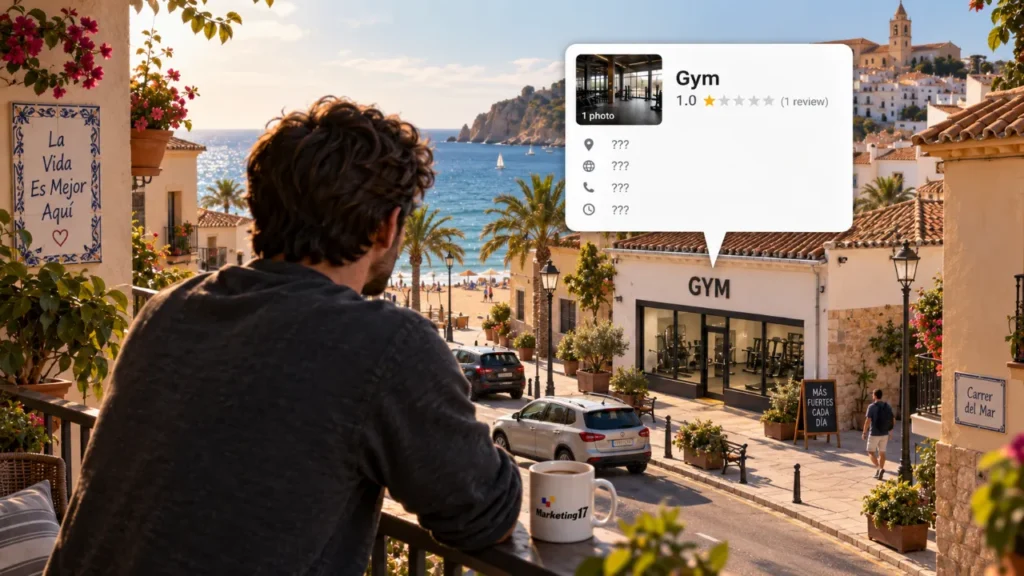
I was on a holiday in northern Spain with my family, and there was a small gym across from my balcony. Hardly anyone seemed to go in or out. Before I walked over, I checked Google Maps for the daily rate, the way I check most things before I bother a stranger with a question. The listing had one photo, dated 2024. One five-star review, no address, no prices, no opening hours, no website. Nothing.
I went anyway, because it was close and I was curious. The owner was mid-class, with four people already training, and I joined in and started lifting. Partway through, he came over and handed me a towel, then went back to the group. When the class ended, I asked what I owed him. “Don’t worry,” he said. “Today was for free.”
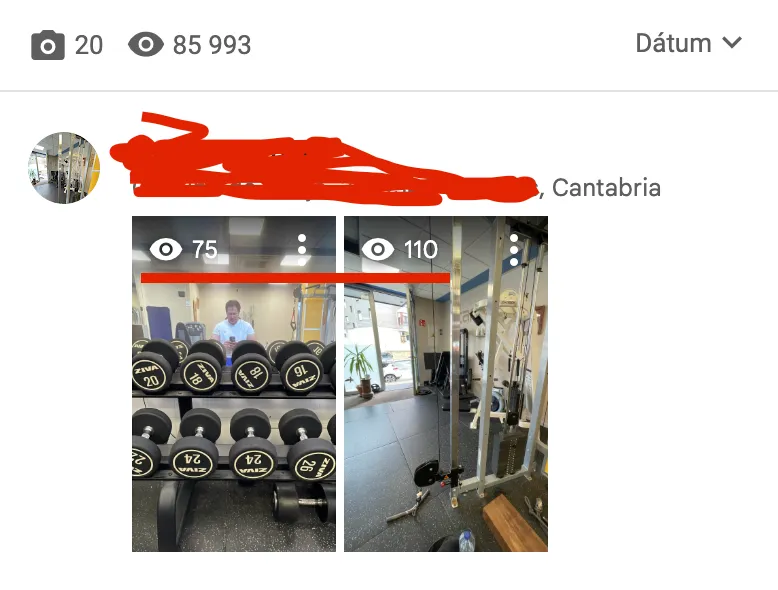
That gym is fine. It has a loyal-enough class of regulars and an owner generous enough to let a stranger train for nothing. What it doesn’t have is anything for a stranger to find before walking in. I only did because it happened to be close enough that curiosity did the rest. Someone without that accident of proximity, checking Maps the way I did, would have found the same three data points I did and, unlike me, no reason at all to go further. That night I couldn’t sleep very well; I was thinking about the gym, and why he wouldn’t fix his Google Maps profile so he could attract more customers. The next day I posted a review with a photo and updated a few things in the profile I could, because he was nice to me and let me train for free.
I checked the results last night. The two photos I posted got 185 views in less than a month. In my opinion, this is a very important lesson for every small business.
The word-of-mouth blind spot
That’s the pattern worth naming: a business can be doing fine—full classes, happy customers—while being close to invisible to anyone who doesn’t already know it exists. Word-of-mouth reputation is real, and for a neighbourhood gym with a stable roster of regulars, it’s probably sufficient. It just doesn’t reach the person who isn’t a regular yet: a tourist, someone who moved to the area last month, anyone passing through without a friend who already goes there. That population has no word-of-mouth network to draw on by definition, so it defaults to whatever Google or Maps happens to show it.
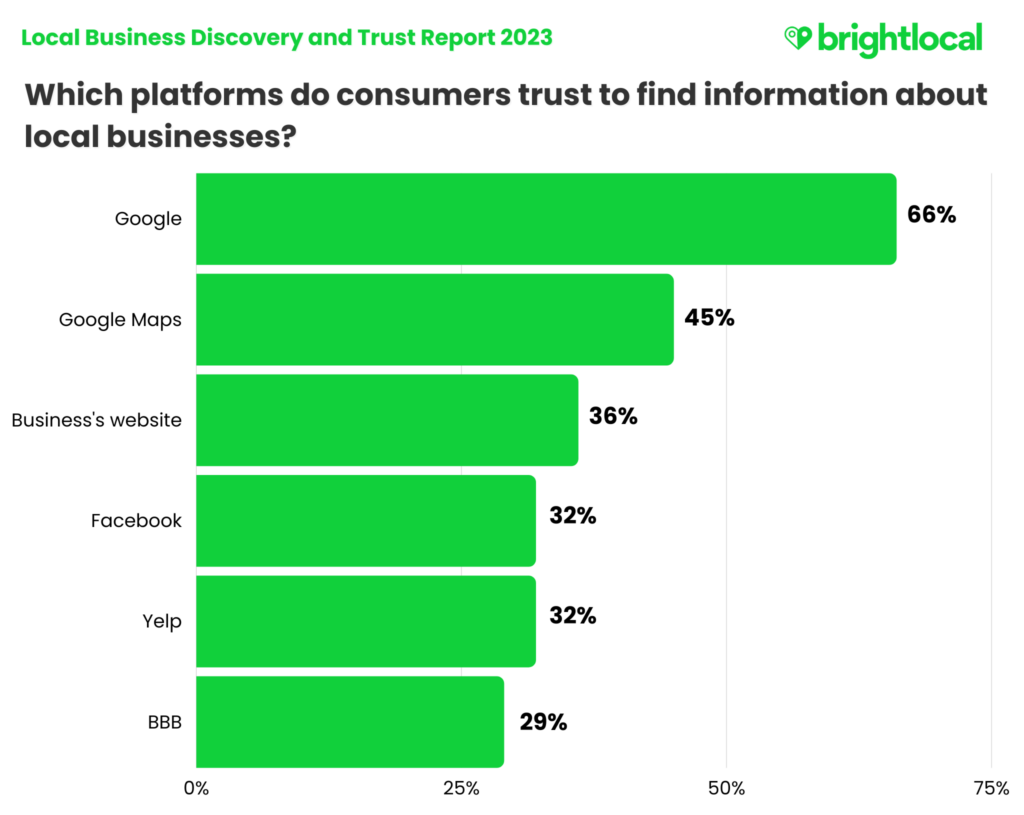
A 2023 BrightLocal survey of 1,138 US consumers found Google itself (66%) and Google Maps (45%) were the most trusted platforms for researching a local business, both ahead of the business’s own website (36%). The survey didn’t segment tourists from locals; it wasn’t built to answer that specific question, and I want to be upfront about that rather than stretch it further than it goes. What it does establish cleanly is that Google and Maps are the default discovery layer for local businesses generally, which is the half of this argument that’s directly measured.
The other half (that visitors and newcomers lean on that layer more than locals do, relative to word-of-mouth) isn’t something I can point to a study for, because I looked and no one seems to have measured it directly. What supports it is the discovery data above, the plain mechanics of the situation (word-of-mouth requires an existing local connection that a visitor hasn’t had time to build), and the gym itself as one concrete case where the gap showed up.
I’m stating that as reasoning, not as a cited statistic, because that’s what it actually is.
What the neglect usually looks like, and what it costs
A Google Business Profile (Google renamed it from “Google My Business” a few years back, same product) is the listing that shows up on Maps and in local search results: hours, photos, a website link, whether it’s been claimed by the business, plus whatever reviews accumulate over time. “Completeness” just means how many of those fields are actually filled in.
Whitespark’s founder, Darren Shaw, analysed 1.8 million Google Business Profiles across more than 4,000 categories for Search Engine Land in August 2026, scoring each one 0–5 on exactly that: website, description, hours, photos, claimed status. Profiles scoring 0 averaged a local-search ranking position around 62, with about 4% reaching the top 10. Profiles scoring a full 5 averaged around position 43, with roughly 13% making the top 10. Call it a 19-place jump and a tripling of top-10 odds across the completeness range.
Shaw is careful to flag that this is correlation, not proof that filling in fields causes the jump: some of the lowest-scoring categories in his data were community organisations and similar groups that may simply have less competitive pressure to optimise, not less capacity to. The gym I visited would likely sit near the bottom of that range (one photo, no hours, no site), and the pattern in the data at least fits what I saw: a business a search engine has almost nothing to work with.
Reviews follow a milder version of the same logic. BrightLocal’s 2025 consumer survey found people have grown more willing to act on a business with a low review count than they were in 2024, but “more lenient” isn’t “indifferent.” Even a forgiving visitor still needs something on the page to react to.
Why this happens
I don’t think this is negligence, and I haven’t found a survey of business owners explaining, in their own words, why they leave their listing bare, so what follows is my own read of the situation, not a reported finding. A business built on a strong, repeat local customer base has very little day-to-day reason to think about a channel that mostly serves people who don’t already know it. The gym owner isn’t losing sleep over his listing because the four people in his class that afternoon didn’t find him through Google. They already knew where the gym was. The listing only matters to the person standing outside it who doesn’t.
Where it actually bites hardest
Picture someone landing in a new city for a work trip, looking for a padel court for one evening. I’m using this as a hypothetical, not a data point. I couldn’t find any real research specifically tying padel or similar racquet-sport bookings to Maps usage, and I’m not going to invent a number to fill that gap. But the mechanism is the same one from the gym: that person has no local contacts to ask, no group chat with a recommendation already in it.
Whatever Maps shows them (hours, a couple of real photos, a website they can actually check availability on) is the entire deciding factor. A locally famous court with an empty listing and a court with half its details filled in are, to that visitor, not even competing; only one of them exists.
What’s actually worth checking
None of this calls for an agency retainer or a redesign. It calls for the handful of fields the data above keeps pointing back to: accurate hours, at least one real photo of the place (not a stock image), a working link to a website or booking page if one exists, and a small, recent stack of reviews so a stranger has something to react to.
A business with regulars will likely keep doing fine either way. How does this look, though, to someone who has never heard of you?
No time to do it yourself? Hire me, and I will help you.
** Drafted by AI – edited by a human.