

Two stories about Google Search spread fast this summer. One said Google had quietly rolled out a new core update in late August; the other said Google had made its AI Mode the default way Chrome handles searches. Neither happened.
What did happen (two confirmed spam updates, one of them genuinely disruptive in August, and a handful of changes to how AI shows up on the results page) is less dramatic than the rumours, but it’s the part worth actually knowing. This is an attempt to separate the two, with sources attached to every claim that matters.
The two spam updates that actually happened
Google ran two spam updates between June and August 2026, and it’s worth being precise about what that term means, because it’s often confused with a core update. A core update reassesses relevance broadly. It changes how Google’s systems weigh quality and usefulness across the web, without targeting a specific behaviour.
A spam update instead targets violations of Google’s spam policies (manipulative practices like cloaking, scaled low-value content, or deceptive redirects), though Google doesn’t disclose which specific policies a given update actually enforces. Both take days to fully apply because Google phases the change across its index rather than flipping it on everywhere at once. That phased period is what the industry calls the “rollout window,” and it’s why a released update and a completed one can be a week or more apart.
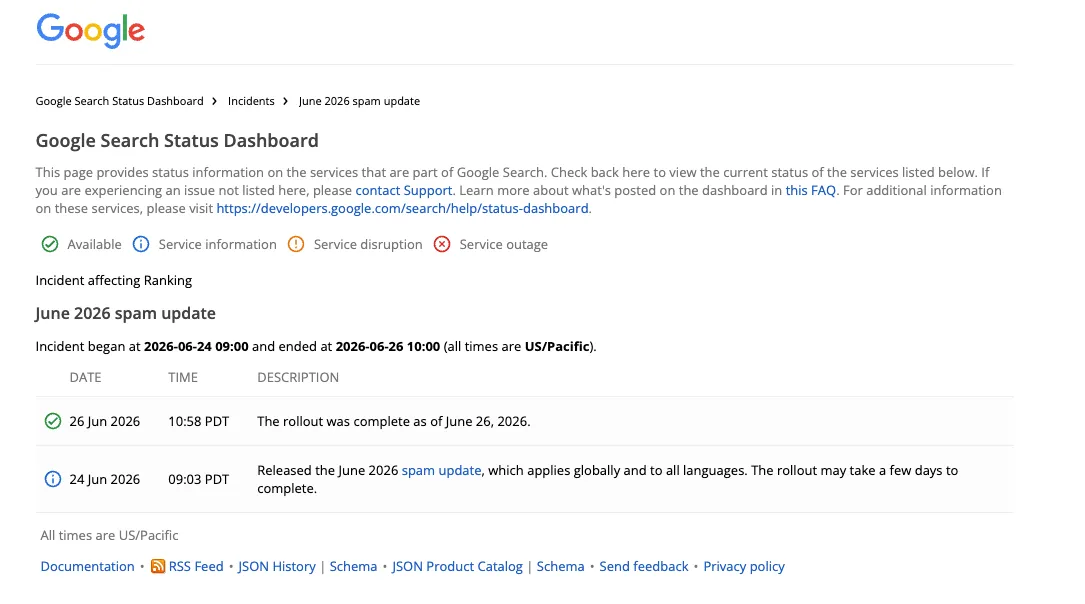
The June 2026 spam update went out on June 24 and finished June 26, about two days, global, all languages. Search Engine Roundtable’s Barry Schwartz, who tracks these closely, described it as feeling “a bit bigger” than the spam update from earlier in the year. The August 2026 spam update started August 18 and didn’t finish until August 20–21, roughly two days and sixteen hours, the slowest rollout of any 2026 spam update.
Neither update targeted link spam or the separate site-reputation-abuse policy, and Google didn’t publish a companion blog post for either. It rarely does for spam updates, reserving those for changes with specific action items for site owners.
What the August update actually did to pages
The August update is the one worth understanding in more detail because it has real numbers behind it. Search Engine Land reported on an SE Ranking analysis of 100,000 U.S. keywords across 20 industries: 16.71% of URLs that had been ranking in Google’s top 10 fell past position 100 for the same keyword during the update window, against a 9.2% baseline measured in July, an 82% relative jump. Volatility ranged from 74.64% (real estate) to 85.55% (fashion and beauty), with YMYL categories like real estate and healthcare showing comparatively less churn than lower-stakes niches.
It wasn’t only losses, either: 12% more URLs reached the top 3 without having ranked in the top 20 before. SE Ranking itself flagged the limits of its own study: no domain-level breakdown, and no way to tell whether a URL that vanished from the top 100 was deindexed or just pushed further down.
For what that volatility looked like on individual sites, SEO consultant Glenn Gabe, who specialises in picking apart these updates site by site, published four anonymised case studies after digging into sites hit by the update. The pattern repeats: an “ultra-YMYL” site that lost over 200,000 queries after mixing scaled content across country variants with chunks of AI-generated text; an Amazon affiliate site down 14,000+ queries, combining thin affiliate content with scraped material Gabe’s tools scored above 97% likely AI-generated; a 1.5-million-URL product site, roughly 85% of it programmatic and adding little value, hit across the board; and a site running misleading redirects that lost around 25,000 queries.
Gabe’s read, based on tracking recoveries from past updates: sites that clean up the actual pattern tend to see it take months of sustained improvement, not a quick fix after one round of edits.
Yep, you can recover from spam updates. You just need to address the spam… and then Google will need to see the improvements over time (typically at least several months). I've seen some sites recover in just a few months. The example from Lily below was five months. Of course,… https://t.co/i8IecNUocm
— Glenn Gabe (@glenngabe) June 24, 2026
The volatility didn’t neatly stop when the rollout did, either. Independent rank-tracking platforms kept recording elevated churn into late August, well after Google’s own status dashboard had marked the update complete. Barry Schwartz floated, as speculation rather than a confirmed finding, that Google might be pushing out something new on top of it. Google never confirmed a cause, and no dashboard entry backs the idea up.
Two rumours that didn’t hold up
The loudest claim circulating in late August was that Google had run a separate core update (on top of the spam update) sometime between August 26 and September 21. It didn’t happen. Google’s own Search Status Dashboard shows nothing in that window beyond the confirmed spam update, and neither Search Engine Land, Search Engine Roundtable, nor Search Engine Journal recorded a core update there either. The tell: that exact 26-day window matches, almost to the day, the August–September 2025 spam update’s actual duration — a detail that suggests whoever originated the claim reused last year’s dates rather than checking this year’s dashboard.
The second rumour involved AI Mode, Google’s fuller, more conversational search experience, distinct from the AI Overviews summary box that sits above regular results on a normal search page. In June, Chrome Canary briefly shipped an experimental flag that redirected address-bar searches straight into AI Mode, and some read it as evidence Google planned to make that the Chrome default. Rajan Patel, Google’s VP of Search Engineering, corrected it directly on X: “this was an error. We’re not planning to make AI Mode the default for Chrome searches.”
Hey Glenn– this was an error. We're not planning to make AI Mode the default for Chrome searches.
— Rajan Patel (@rajanpatel) June 5, 2026
Where the results page itself is moving
Separate from the update cycle, Google kept reshaping what a results page looks like. As of late August, AI Overviews now fully expand by default for some queries (no “Show more” click required), pushing traditional organic results further down; Google says its own data shows people engage more with the expanded format, but hasn’t said what share of queries this applies to.
Search Console also gained a dedicated report showing a site’s impressions inside AI Overviews, AI Mode, and AI-powered Discover, rolled out worldwide by August 31, though it doesn’t yet include clicks, CTR, or average position; there’s also a matching opt-out toggle Google says isn’t used as a ranking signal elsewhere. Interestingly, Google adds AI Overviews and AI Mode queries to Search Console, so we can see what people are asking from AI and which page shows up for it from our website.
You can filter, for example, for 5 or more words with this Regex filter:
^(?:\S+\s+){5}\S+(?:\s+\S+)*$
This is a good start, but if you would like a better approach, you can try Suganthan’s AI Mode and AI Overview query classifier here. Drop the query export and the Generative AI report in the boxes, and the classifier will tell you what queries seem to be involved with AI.
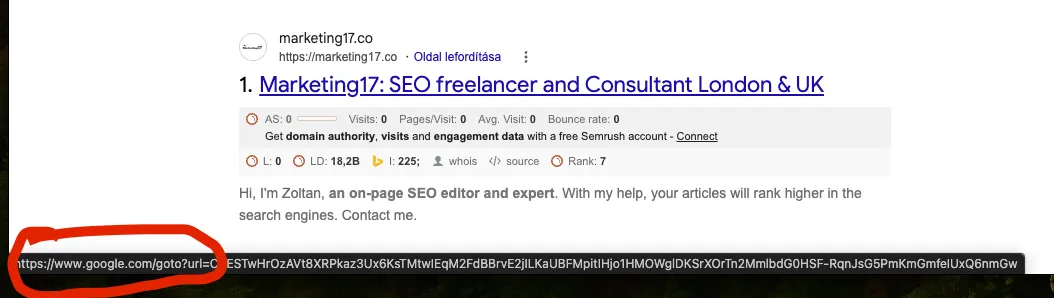
A few smaller, lower-confidence items rounded out the window: Preferred Sources badging extended into AI Overviews and AI Mode, Google stopped enforcing manual site-reputation-abuse actions for EEA searchers under regulatory pressure, and Google began routing result clicks through a new google.com/goto redirect while amending its lawsuit against SerpApi over scraped search data.
So when’s the next one?
There’s no announced date, and Google has been explicit that there won’t be one in advance. Asked whether core updates roll out in stages, Google’s John Mueller answered that there’s “not a single ‘core update machine'” that gets switched on. Updates ship based on whatever teams have been working on, which is why some take longer than others.
The record does show a pattern: five named updates landed between March and August 2026, spaced roughly six to seven weeks apart. That’s a rhythm, not a forecast, and treating it as a schedule is exactly the kind of overreach that produced this summer’s fake core-update claim. What’s confirmed is that the spam side isn’t winding down — when a practitioner publicly asked whether Google’s spam team remained adequately resourced given AI priorities, Patel’s reply was two words: “Yes, it is.”
For a site owner, the useful response to that isn’t watching a calendar. Gabe’s case studies point to the actual exposure: heavy reliance on programmatic content that adds little beyond template variation, AI-generated text used to pad thin pages, and redirect or affiliate patterns that read as manipulative rather than useful. None of that needs a specific update date to fix.
*** Article is drafted by AI – checked by a human.